
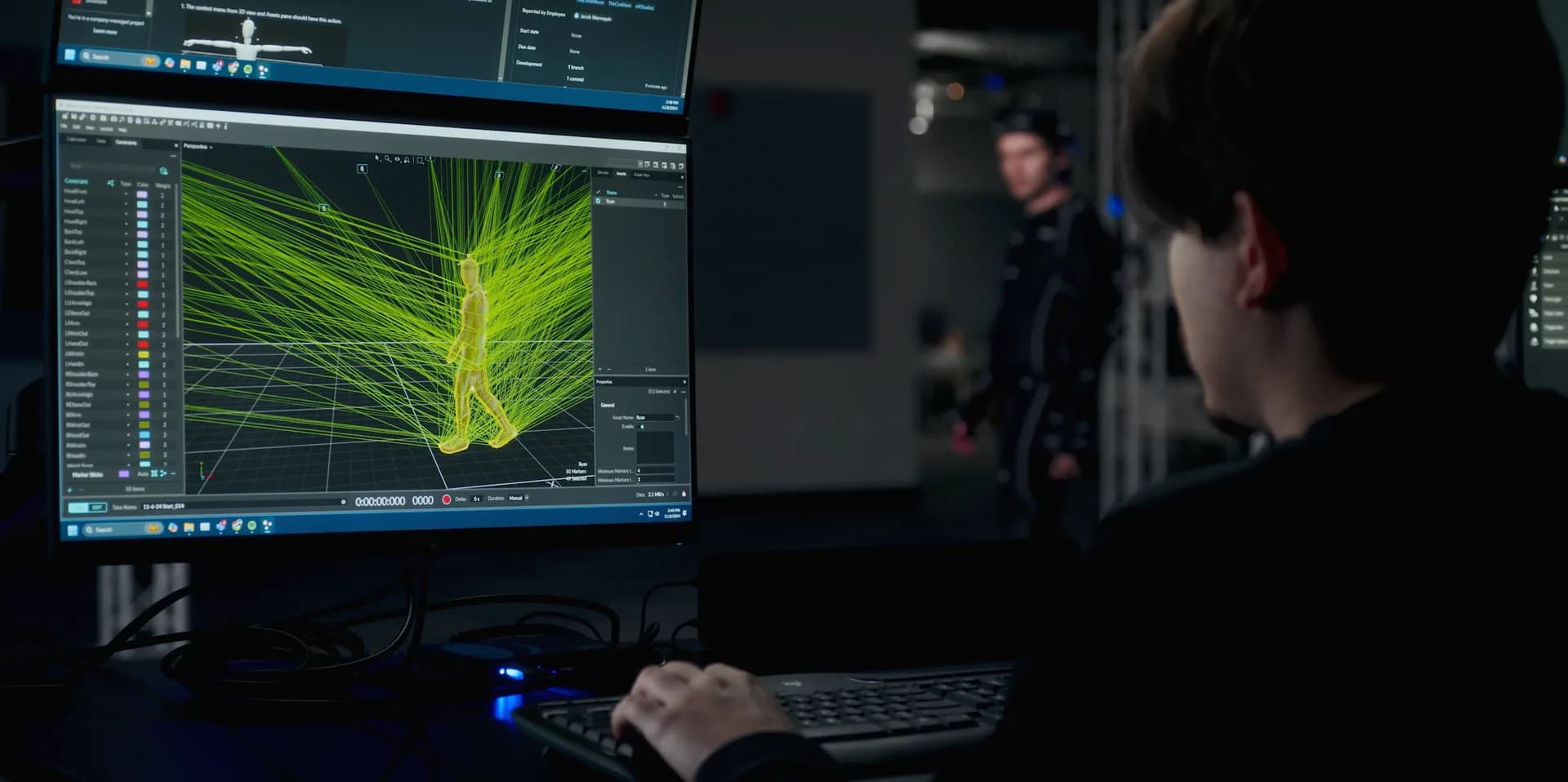
OptiTrack: The latest in motion capture, hands-on
Partner: OptiTrack, a Motion Capture Technology Company
Technologiezentrum Horb
Topics & systems
- Markerless full-body tracking
- Duplex Mode
- Continuous Calibration
- Virtual markers
- System setup
Station · TRACKING DAY 2026
Partner: OptiTrack, a Motion Capture Technology Company
Technologiezentrum Horb
Topics & systems
90 minutes of hands-on in a small group: OptiTrack shows its system in real-world use. You test it yourself, ask your questions and compare the approach directly with the three other stations of the day.
Registration is closed.
OptiTrack develops optical motion capture cameras, Motive software, and tracking tools for measuring the movement of people and objects. Its systems support applications across robotics, movement science, animation, virtual production, and immersive experiences.
At Tracking Day, meet the team and explore how OptiTrack’s latest capabilities could fit your work.
OptiTrack provides external position and orientation measurements for robots, drones, and tracked objects. Engineering teams can compare these measurements with onboard estimates to evaluate localization, identify drift, and validate motion. This gives developers a reference for assessing how their systems perform in a controlled tracking environment.
Track headsets, controllers, and physical props in a shared coordinate system to connect real movements with virtual environments. OptiTrack streams tracking data into tools such as Unreal Engine and Unity, supporting immersive training and interactive simulations in which the position of a physical object drives its virtual counterpart.
Study how people move and interact with objects using marker-based or markerless workflows suited to the research question. With Duplex Mode, compatible cameras capture marker data and synchronized reference video together, giving researchers a visual record alongside motion measurements for reviewing captures and developing human-motion datasets.
Use a calibrated measurement probe to capture points on physical objects and record their 3D coordinates. These points can be used to calculate distances and angles or define reference locations for engineering and research workflows, helping teams bring physical measurements into digital analysis.